Large-trader activity

Hyperliquid whale tracker and large trade alerts

Proliquid Whales surfaces large public Hyperliquid trades and liquidation events so you can see where meaningful size is entering, exiting, or being forced out of a market.

A whale print is evidence of activity, not a complete trading thesis. Proliquid links the market and public address context to charts, orderbook depth, funding, news, and Spectate mode so you can decide whether to follow, fade, or ignore it.

Free to explore · Connect a wallet only when you are ready to trade

  • Large Hyperliquid trades and liquidations
  • Public whale-address activity over time
  • Market links for chart and execution context

Follow meaningful size

Know what printed, and what you still need to learn.

The feed makes large activity visible quickly, while the surrounding workflow helps prevent a single print from becoming an unsupported assumption.

Flow

Large trade alerts

High-notional Hyperliquid trades reveal when substantial public activity appears on a market and which direction the print took.

ValidateCheck whether price moved with the trade or whether available liquidity absorbed it.

Behavior

Repeated address activity

See when the same public address appears across multiple events, then use Spectate mode and public explorers for additional context.

ValidateLook for a pattern across time rather than inferring intent from one transaction.

Stress

Large liquidation events

Whale liquidations show when a large position was forced out by exchange risk mechanics during a market move.

ValidateCompare the event with the Liquidations view and chart to see whether forced flow continued.

Context

One-click market follow-through

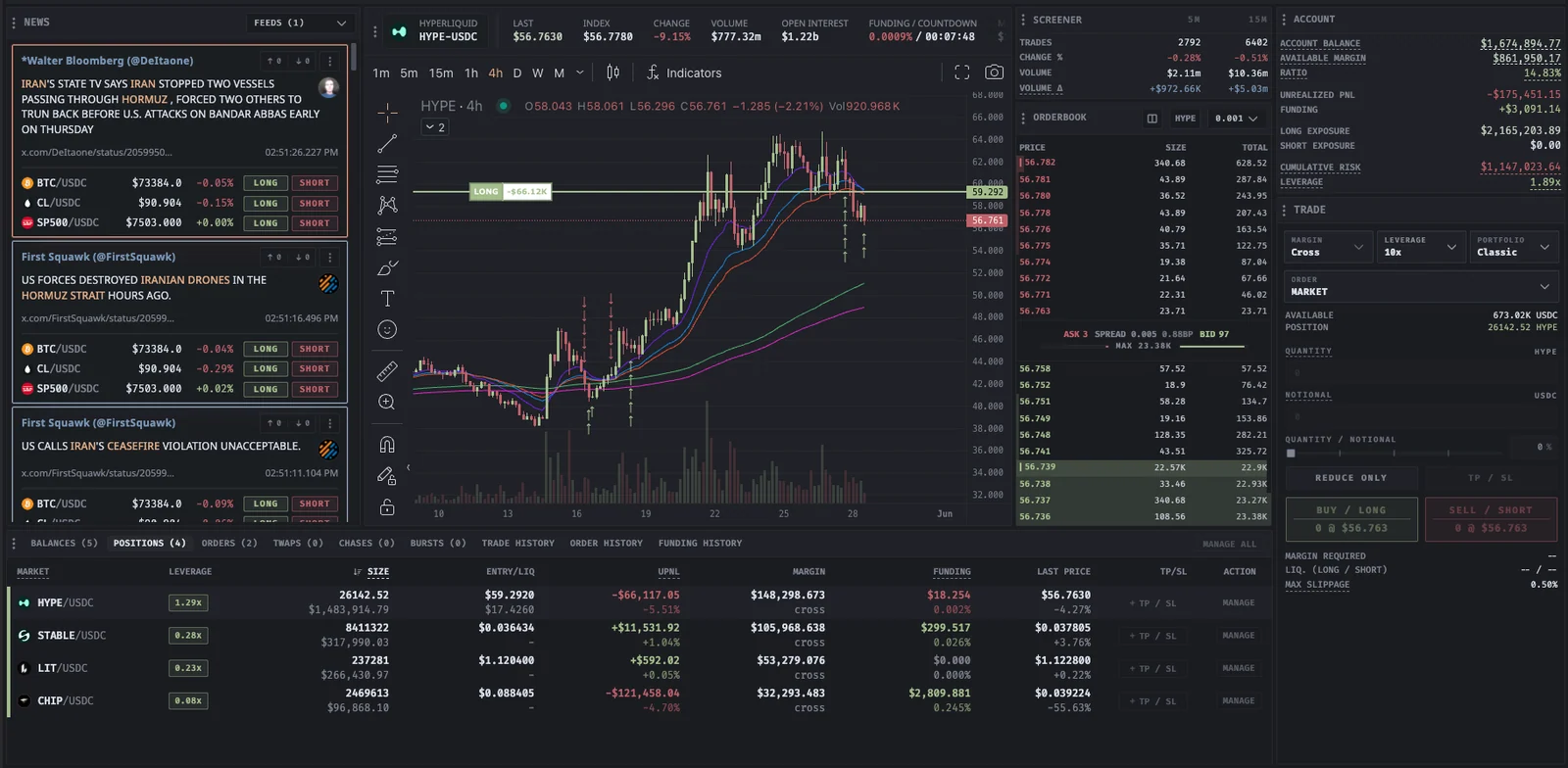
Open the related market in Terminal to inspect price, orderbook depth, news, mini-screener metrics, account exposure, and execution choices.

ValidateBuild your own plan independently from the whale's unknown risk, time horizon, and portfolio.

Whale validation workflow

Observe the whale. Trade your own evidence.

Public large-trader data is most useful when it prompts better questions about timing, liquidity, and broader confirmation.

Read the product guide
  1. Classify the event

    Separate a large trade from a forced liquidation, note the market and direction, and identify whether the address has appeared repeatedly.

  2. Inspect public context

    Use Spectate mode or linked explorers to review visible address context while remembering that other wallets, venues, or hedges may be hidden.

  3. Test market confirmation

    Compare price reaction, volume, depth, news, funding, and liquidation zones to determine whether the activity changed the wider market.

  4. Create an independent plan

    Decide your entry, invalidation, size, leverage, and order type from your own account and risk constraints, not the whale's notional.

Whale-data limitations

A public address is only one window into a trader.

Large trades are attention signals. They rarely reveal the complete portfolio, motive, or time horizon behind the activity.

Unknown intent

The event may open risk, close risk, hedge another position, rebalance exposure, or move collateral. Direction alone cannot answer that.

Incomplete portfolio view

A trader may use multiple wallets, centralized exchanges, options, spot holdings, or off-chain positions that are not visible here.

Follower disadvantage

Copying after a large print can mean entering later, at a worse price, with different liquidity and without the whale's exit plan.

Before you trade

Questions about this workflow

Product behavior and limits, explained without trading promises.

What triggers a Hyperliquid whale alert in Proliquid?

Proliquid surfaces high-notional public Hyperliquid trades and large liquidation activity in the Whales feed. The event includes market and address context for deeper inspection.

Can I see the whale's public address?

When address information is available, Proliquid can link to public context and Spectate mode. Spectate mode is read-only and does not grant control over another wallet.

Should I copy a large Hyperliquid trade?

A large trade can be a hedge, exit, rebalance, or partial portfolio action. Check price reaction, liquidity, news, funding, and repeated behavior, then make an independent decision based on your own risk.

How are whale trades different from liquidations?

A large trade is a high-notional public execution. A liquidation is a forced position reduction caused by exchange risk mechanics. Each requires different interpretation and follow-up checks.

Watch the size

Follow large activity without following it blindly.

See the print, inspect the public context, and validate the market before deciding whether it belongs in your plan.